

’Tis the Season for Year-End Tax Planning
Fall brings cooler weather, pumpkin spice, family gatherings, and the start of the holiday season. It’s also a great time to review your finances and identify opportunities to manage your tax bill before we ring in 2027. A few thoughtful decisions before December 31 can make a meaningful difference when tax season arrives.
Here are some year-end tax planning strategies to consider as you prepare for the year ahead.
Standard vs. Itemized Deductions
Before making year-end financial decisions, it’s important to understand whether you expect to take the standard deduction or itemize deductions on your 2026 tax return.
For 2026, the standard deduction is $16,100 for single filers and $32,200 for married couples filing jointly. Taxpayers age 65 and older may qualify for additional deductions, depending on their circumstances.
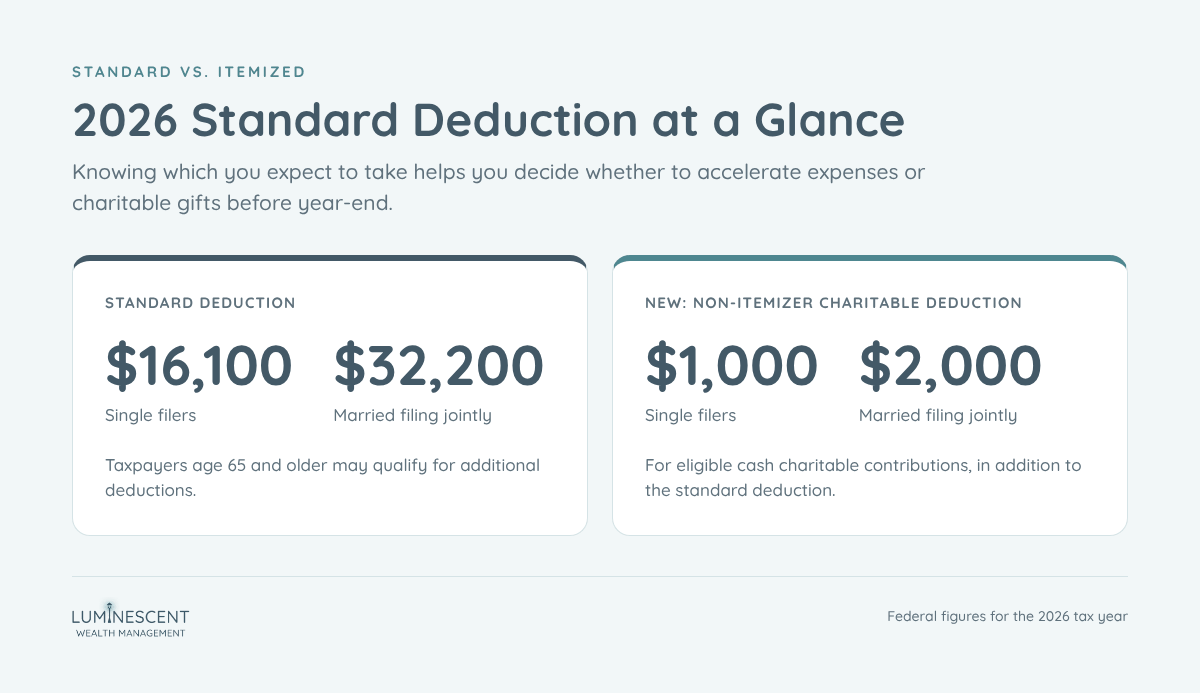
If you typically take the standard deduction, expenses such as charitable contributions, state and local taxes, and qualifying medical expenses may not provide an additional federal tax benefit. However, beginning in 2026, taxpayers who take the standard deduction may also qualify for a separate deduction for eligible cash charitable contributions, up to $1,000 for single filers and $2,000 for married couples filing jointly.
Understanding your expected deductions can help you determine whether it makes sense to accelerate certain expenses or charitable gifts before year-end.
Does It Make Sense to “Bunch” Deductions?
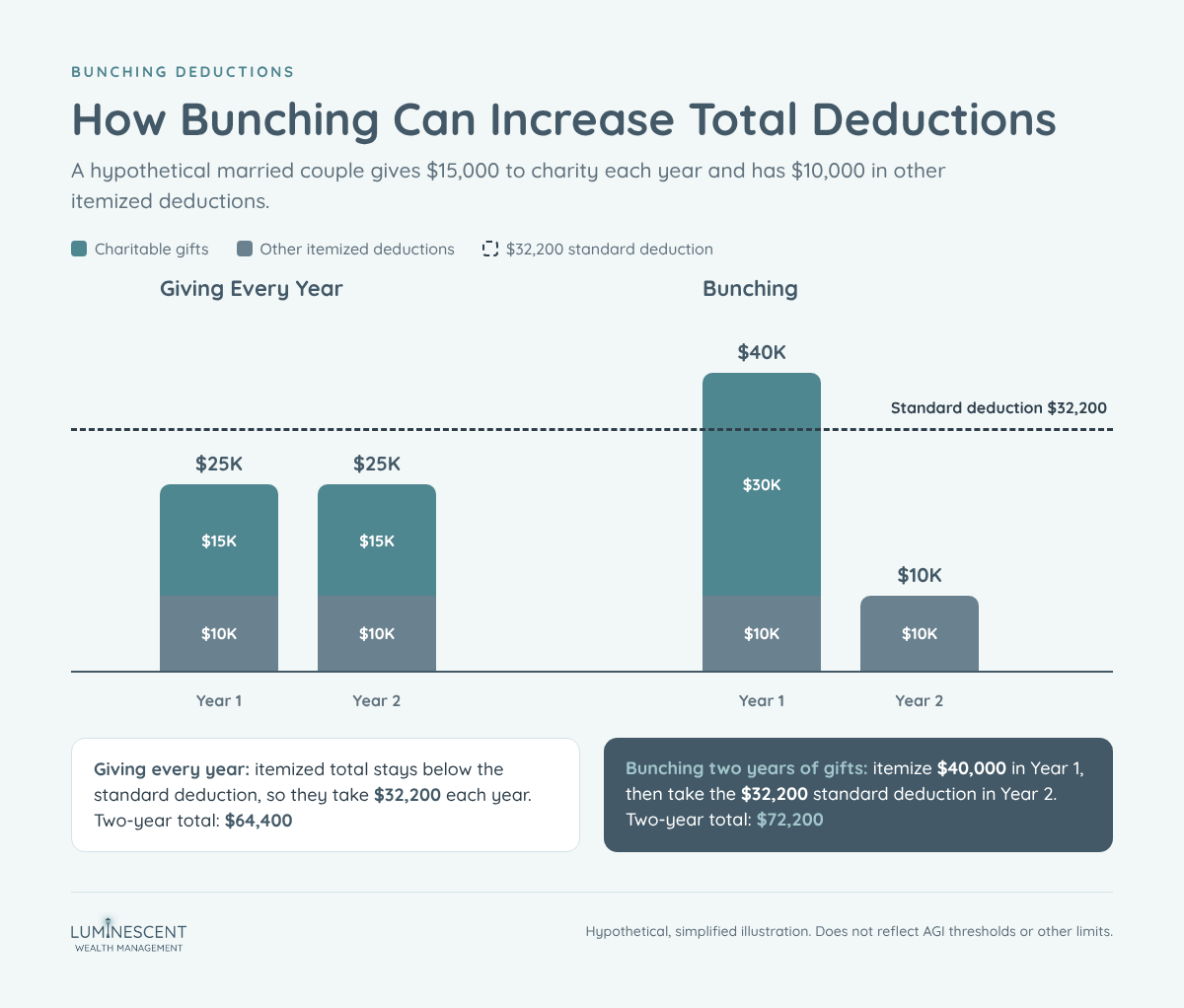
If your deductible expenses are close to, but do not exceed, the standard deduction, a strategy known as “bunching” may help maximize your tax benefits.
For example, if you typically donate $15,000 to charity each year but do not have enough other deductions to itemize, you could consider:
- Combining two years of charitable contributions into one year by making a larger gift before December 31.
- Itemizing deductions in the year of the larger contribution, if your total eligible deductions exceed the standard deduction.
- Taking the standard deduction the following year, when you make fewer charitable contributions.
The same concept may apply to other deductible expenses, such as state and local taxes or elective medical and dental procedures. Medical expenses are deductible only to the extent they exceed 7.5% of adjusted gross income (AGI).
Keep in mind that beginning in 2026, itemized charitable deductions are subject to a new 0.5% of AGI threshold. This makes it especially important to evaluate the timing and amount of charitable gifts as part of your broader tax plan.
Charitable Contributions – Gifting Cash vs. Appreciated Securities
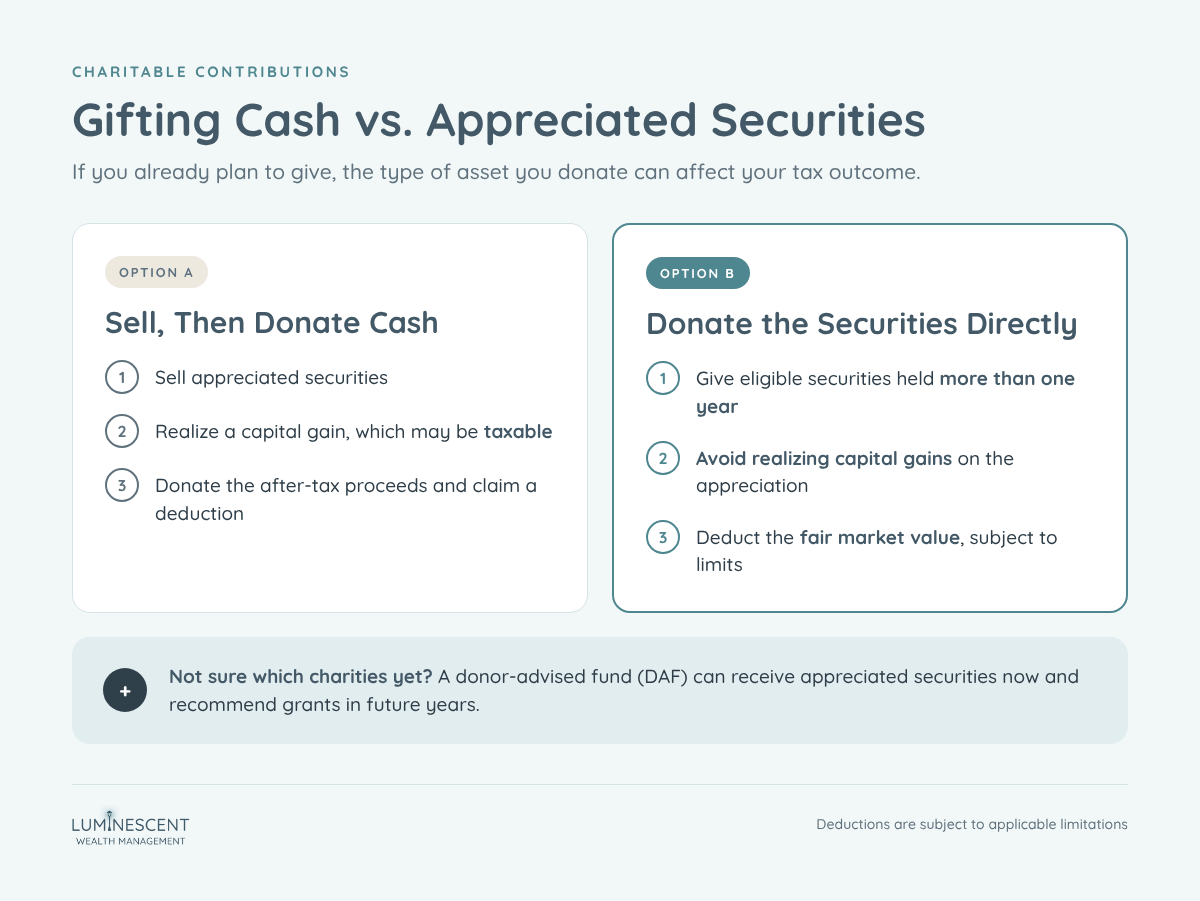
If you already plan to make charitable contributions, donating appreciated securities instead of cash can be a tax-efficient strategy. When you donate eligible securities held for more than one year, you may be able to:
- Claim a charitable deduction based on the fair market value of the securities, subject to applicable limitations.
- Avoid realizing capital gains on the appreciation that would generally result from selling the securities first.
You can consider using the cash you would have donated to purchase other investments or reinvest in your portfolio, potentially resetting the cost basis of the investments purchased.
If you want to take advantage of a charitable deduction but have not yet decided which charities to support, consider funding a donor-advised fund (DAF) with appreciated securities. You may receive a deduction in the year of the contribution, subject to applicable limitations, while retaining flexibility to recommend grants to charities in future years.
A DAF can be particularly useful when you have a higher-income year or want to coordinate charitable giving with a bunching strategy. However, contributions are irrevocable, and the sponsoring organization has legal control over the donated assets.
Qualified Charitable Distributions (QCDs)
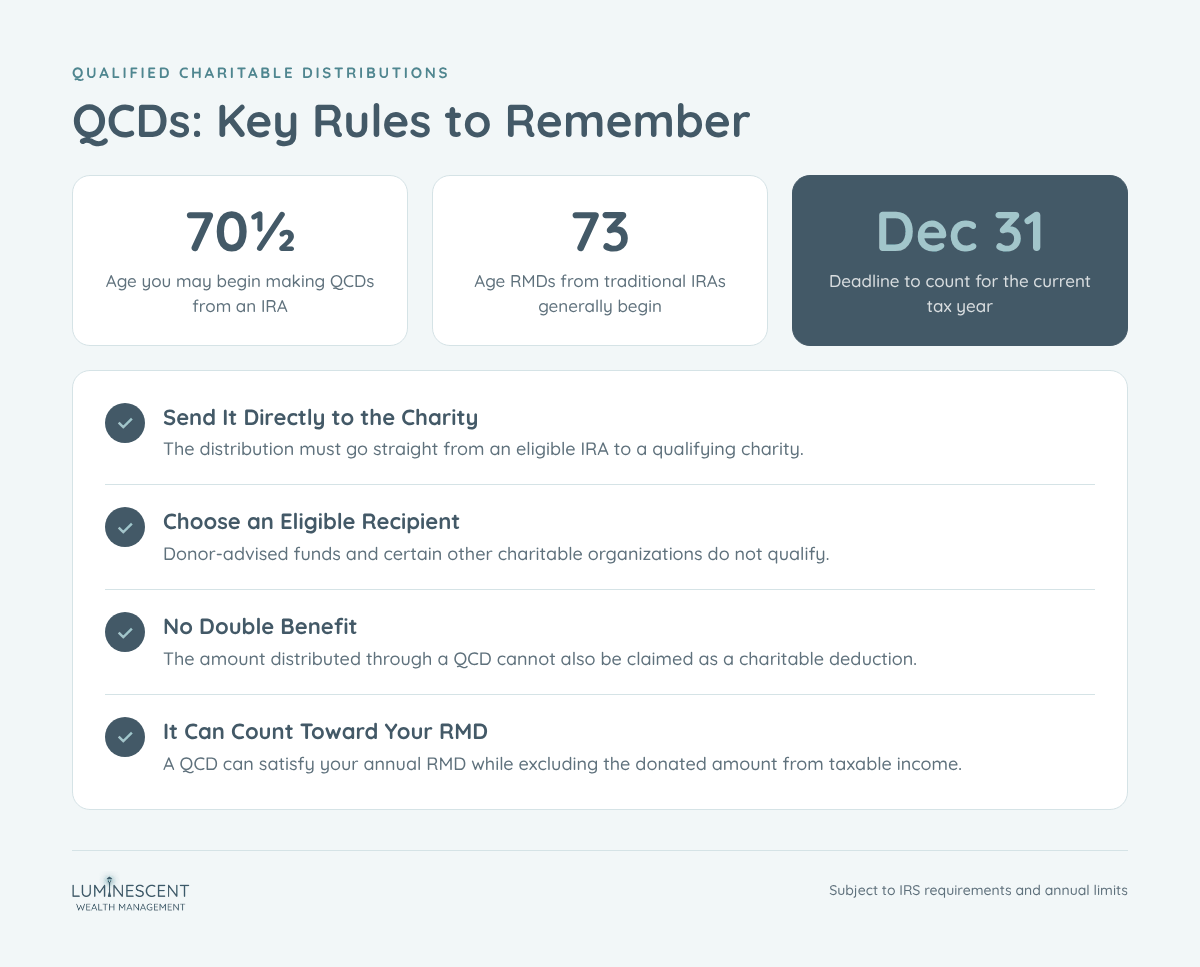
If you are charitably inclined and have an IRA, a Qualified Charitable Distribution (QCD) may be another effective tax planning strategy.
Taxpayers generally must begin taking required minimum distributions (RMDs) from traditional IRAs at age 73. These distributions are generally taxable as ordinary income. However, eligible IRA owners age 70½ or older may make a QCD directly from an IRA to a qualifying charity.
A QCD can count toward satisfying your annual RMD while excluding the donated amount from taxable income, subject to IRS requirements and annual limits.
Key rules to remember:
- The distribution must be made directly from an eligible IRA to a qualifying charity.
- Donor-advised funds and certain other charitable organizations do not qualify.
- The amount distributed through a QCD cannot also be claimed as a charitable deduction.
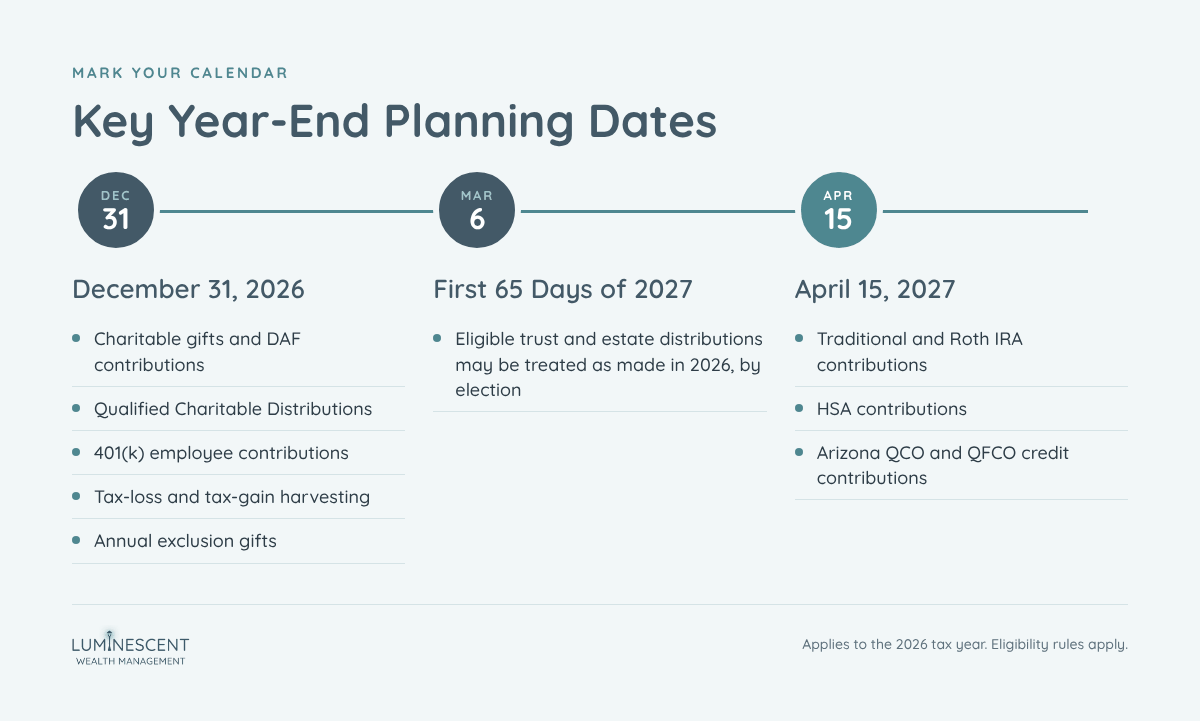
- The distribution must be completed by December 31 to count for the current tax year.
If you were already planning to make charitable gifts and do not need your full RMD to cover living expenses, a QCD may be worth considering. If you need the cash from your RMD, donating appreciated securities from a taxable investment account may be an alternative worth evaluating.
Utilizing IRA Tax Withholding
The IRS generally treats federal income tax withheld from IRA distributions as though it were paid evenly throughout the year, even when the withholding occurs late in the year. This differs from estimated tax payments, which are generally credited to the periods in which they are paid.
As a result, withholding taxes from an IRA distribution may help reduce or avoid underpayment penalties, particularly if you did not make sufficient estimated tax payments earlier in the year.
If you expect your RMD to be sufficient to cover your remaining tax withholding needs, it may be worth considering whether to take the distribution later in the year and withhold an appropriate amount for federal and state taxes. This can allow more of your IRA assets to remain invested for longer.
However, this strategy should be coordinated with your cash flow needs, other income sources, and RMD deadlines. State tax withholding rules may also differ from federal rules.
Harvesting Gains or Losses In Your Portfolio
Year-end is a good time to review your investment portfolio for opportunities to manage taxable income and capital gains.
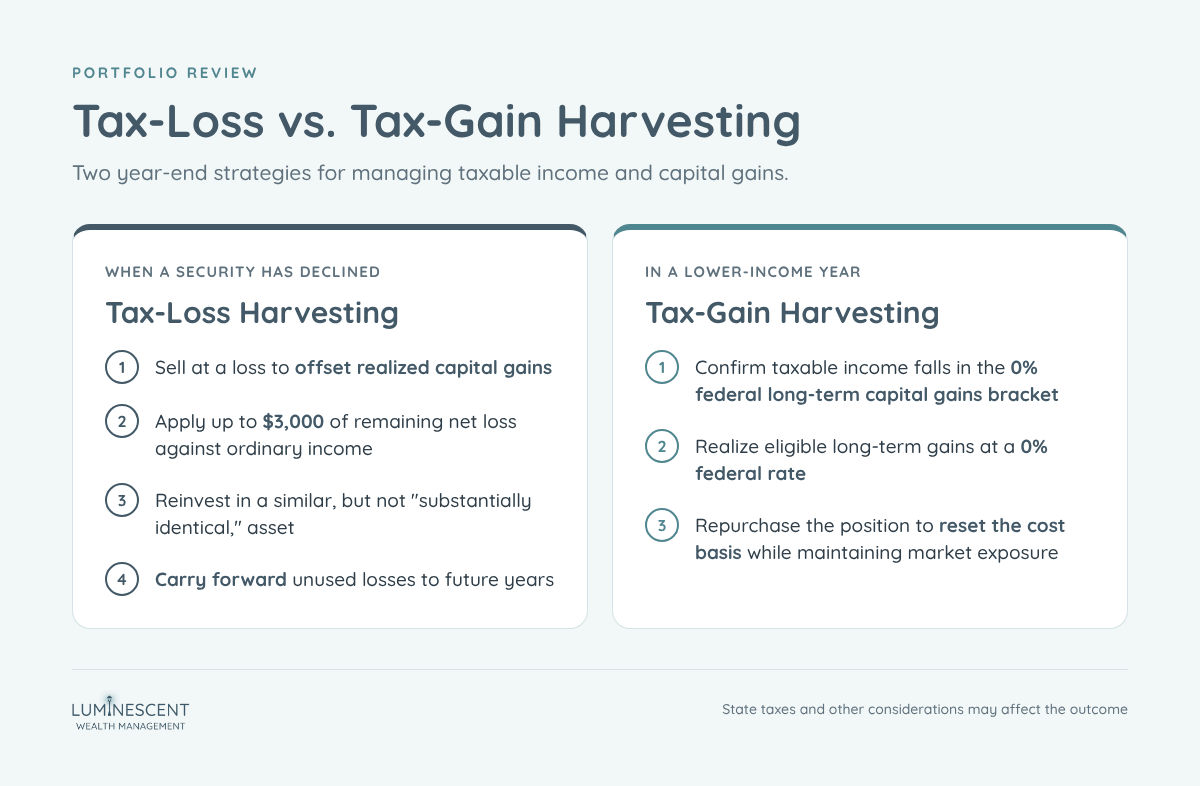
Tax-Loss Harvesting
- If a security has declined in value, selling it at a loss can offset realized capital gains and, if total capital losses exceed capital gains, up to $3,000 of the remaining net capital loss against ordinary income.
- The proceeds can be reinvested in a similar, but not “substantially identical” asset, which maintains market exposure.
- Unused realized losses become a tax asset that can be carried forward into future years to offset gains or income.
Tax-Gain Harvesting (In Low-Income Years)
- Taxpayers whose taxable income falls within the 0% federal long-term capital gains tax bracket may be able to realize eligible long-term capital gains at a 0% federal tax rate.
- Immediately repurchasing the same position after selling it for a gain can effectively reset the cost basis while maintaining market exposure.
Both strategies should be evaluated in the context of your overall income, portfolio objectives, and future tax expectations. State taxes and other tax considerations may affect the outcome.
Utilizing Arizona Tax Credits (For AZ Filers)
While federal tax planning often takes center stage, Arizona tax credits can also provide meaningful opportunities to support causes you care about while reducing your state income tax liability.
Arizona offers individual income tax credits for qualifying contributions to certain charitable organizations, foster care organizations, public schools, and school tuition organizations, among others.
For 2026, the maximum Arizona tax credit contributions are:
- Qualifying Charitable Organizations (QCOs): $506 for single filers and $1,009 for married couples filing jointly.
- Qualifying Foster Care Charitable Organizations (QFCOs): $632 for single filers and $1,262 for married couples filing jointly.
-
Public School Tax Credit: $200 for single filers and $400 for married couples filing jointly.
-
Original School Tuition Organization: $787 for single filers and $1,570 for married couples filing jointly.
-
Switcher School Tuition Organization: $784 for single filers and $1,561 for married couples filing jointly.
-
Military Family Relief Fund: $200 for single filers and $400 for married couples filing jointly. **This donation must be made by 12/31/26.
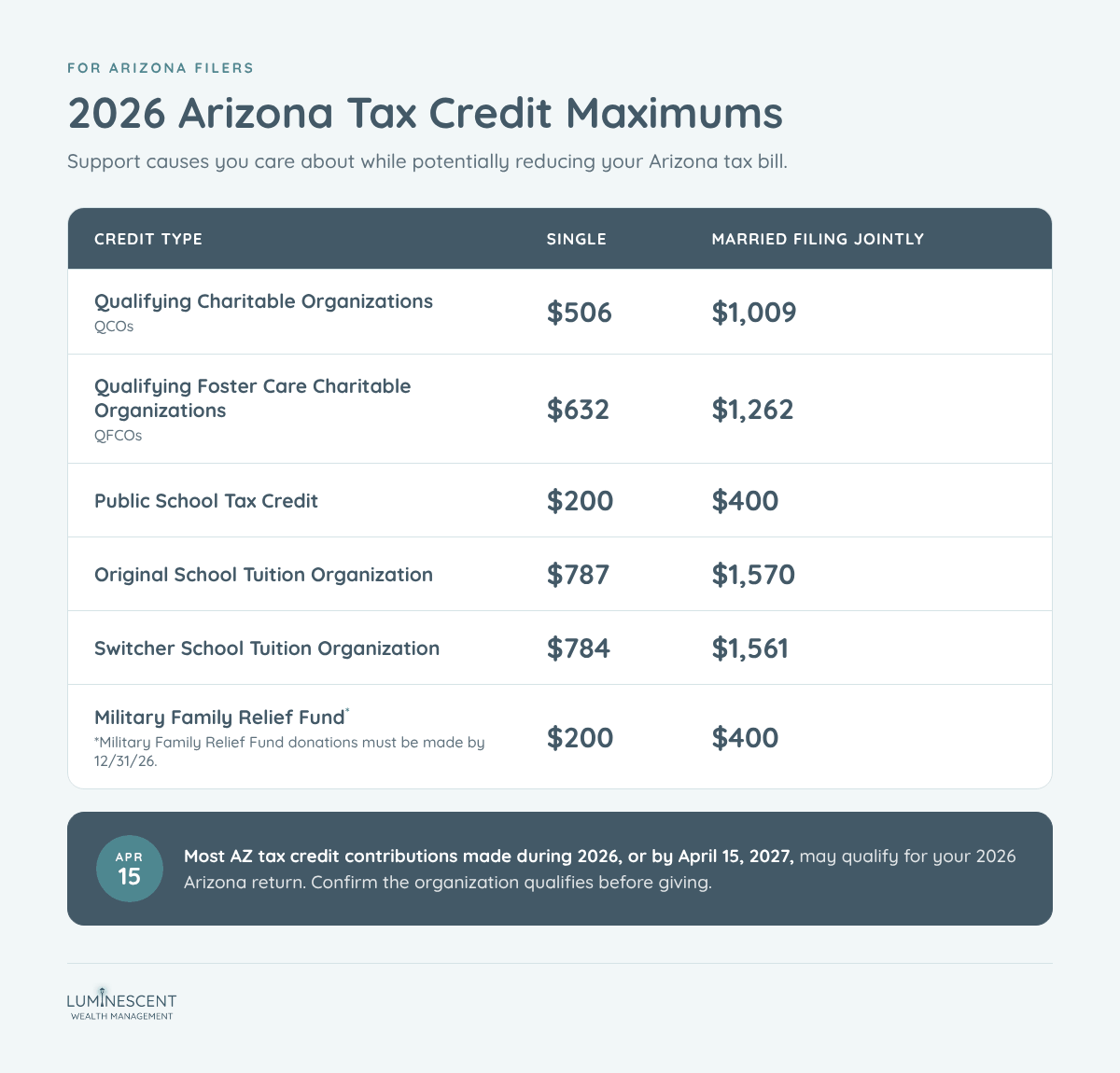
Eligible contributions to QCOs and QFCOs made during 2026, or by April 15, 2027, may qualify for the 2026 Arizona tax return, subject to applicable requirements. Other Arizona credits have their own eligibility rules and limits.
Visit the Arizona Department of Revenue’s website for additional information and lists of eligible organizations.
These credits can be a great way to support organizations making a difference in our community while potentially reducing your Arizona tax bill. Before making a contribution, confirm that the organization qualifies and that you can benefit from the credit.
Retirement Plan and HSA Contributions
Year-end is also a good time to review contributions to retirement plans and health savings accounts.
Retirement Plan Contributions
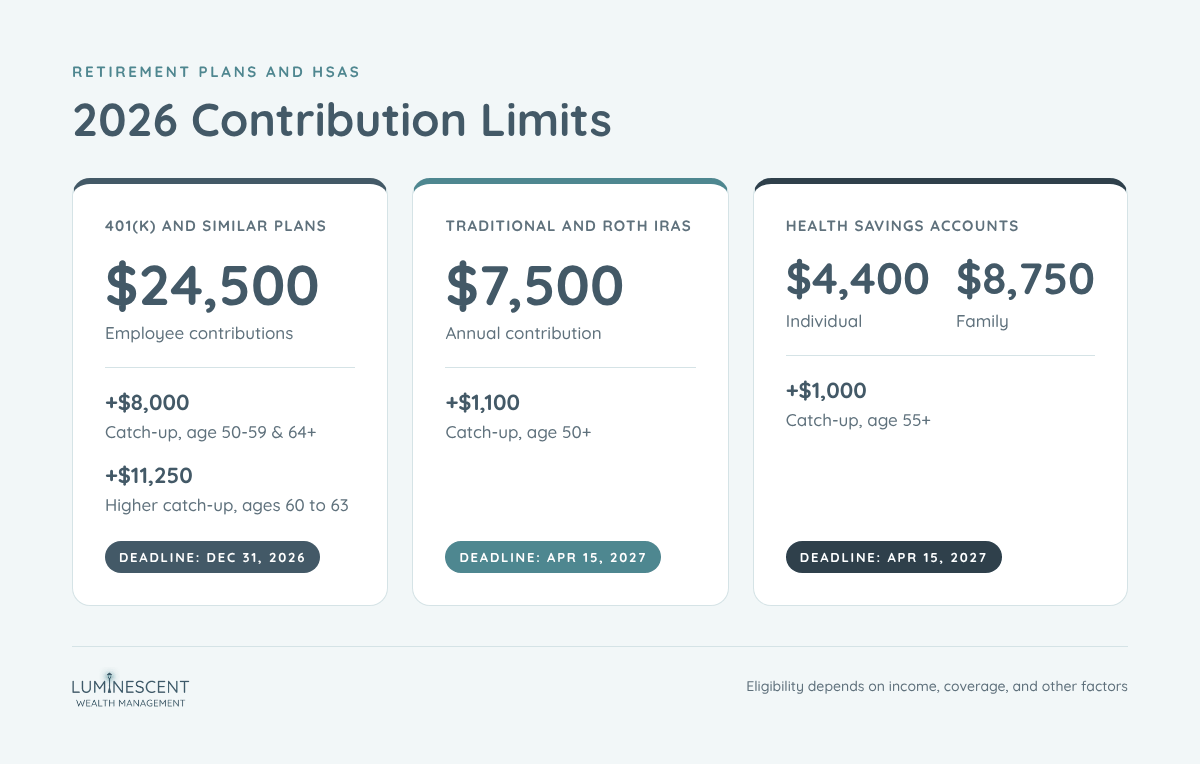
For 2026, key contribution limits include:
- 401(k) and similar employer-sponsored plans: $24,500 for employee contributions, plus an $8,000 catch-up contribution for eligible participants age 50 and older. Participants ages 60 through 63 may qualify for a higher catch-up limit of $11,250.
- Traditional and Roth IRAs: $7,500, plus a $1,100 catch-up contribution for eligible individuals age 50 and older.
Employee contributions to employer-sponsored plan contributions generally must be made by December 31, while IRA contributions for 2026 can generally be made through the April 15, 2027, tax filing deadline. Eligibility for deductible traditional IRA contributions and Roth IRA contributions depends on income and other factors.
Health Savings Account (HSA) Contributions
If you are enrolled in an eligible high-deductible health plan, you may be able to contribute to an HSA. For 2026, the contribution limits are $4,400 for individual coverage and $8,750 for family coverage, with an additional $1,000 catch-up contribution available to eligible individuals age 55 and older.
HSA contributions may be tax-deductible or excluded from income, depending on how they are made. Earnings grow tax-free, and withdrawals used for qualified medical expenses are tax-free.
Eligible contributions for 2026 can generally be made through April 15, 2027. Be sure to confirm your eligibility and applicable limits before contributing.
Retirement and HSA contributions can support both long-term financial goals and tax planning. Reviewing your contributions before year-end can help ensure you are taking advantage of available opportunities.
Distributing Income from Trust and Estate Accounts
Trusts and estates can reach the highest federal income tax brackets at relatively low income levels. Depending on the terms of the trust, distributing income to beneficiaries in lower tax brackets may reduce the overall tax burden.
Trustees should review income distributions annually, considering not only tax implications but also the beneficiaries’ needs, the trust’s distribution provisions, and long-term estate planning goals.
Many trusts and estates may also be eligible to elect to treat certain distributions made within the first 65 days of the following year as though they were made in the prior tax year. This can provide additional flexibility when managing taxable income, but the election is subject to specific rules.
Trust and estate distribution decisions are best coordinated with your financial, legal, and tax advisors to ensure they support both tax efficiency and broader family objectives.
Annual and Lifetime Gifting
For those who want to help children, grandchildren, or other loved ones financially, year-end is a natural time to review gifting plans.
For 2026, you can generally gift up to $19,000 per recipient without using any of your lifetime gift and estate tax exemption or filing a federal gift tax return, assuming the gift qualifies for the annual exclusion. Married couples may be able to give a combined $38,000 per recipient if the applicable requirements are met.
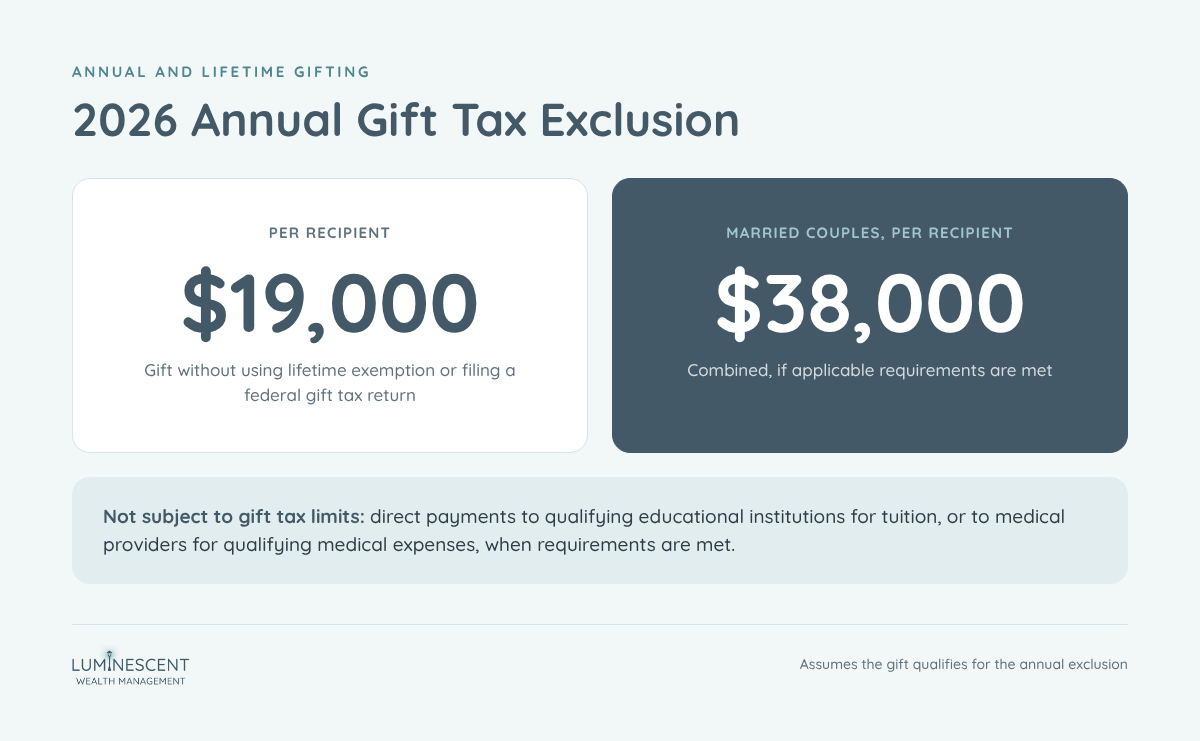
Gifts can take several forms, including cash, securities, and contributions to eligible custodial or education accounts. Direct payments made to qualifying educational institutions for tuition or to medical providers for qualifying medical expenses are generally not subject to gift tax limits, provided the payments meet the applicable requirements.
For those with larger estates, gifting can also be part of a broader wealth transfer strategy. The right approach depends on your financial needs, estate plan, and long-term goals.
Thoughtful gifting can help you share your wealth during your lifetime while supporting the people and causes that matter most to you.
Year-end tax planning is about more than reducing this year’s tax bill. It’s an opportunity to make thoughtful decisions that support your charitable interests, investment strategy, retirement goals, and long-term financial plan.
These are just a few strategies to consider before we ring in 2027. We encourage clients to contact their Luminescent team to review options, evaluate potential impacts, and discuss strategies that may align with their broader financial goals.
Happy year-end tax planning!
This presentation is not an offer or a solicitation to buy or sell securities. The information contained in this presentation has been compiled from third-party sources and is believed to be reliable; however, its accuracy is not guaranteed and should not be relied upon in any way whatsoever. This presentation may not be construed as investment, tax or legal advice and does not give investment recommendations. Any opinion included in this report constitutes our judgment as of the date of this report and is subject to change without notice.
Additional information, including management fees and expenses, is provided on our Form ADV Part 2 available upon request or at the SEC’s Investment Adviser Public Disclosure website, www.adviserinfo.sec.gov. Past performance is not a guarantee of future results.