
“We cannot direct the wind, but we can adjust the sails.”
― Dolly Parton
The economy rarely moves in a single direction, and its effects are not always felt equally. Higher gasoline prices are hard to miss on a trip to the pump, while rising bond yields may receive less attention despite their influence on mortgage rates, business financing, and investment decisions. A business can be growing while facing higher costs, and the stock market can advance even as borrowing becomes more expensive.
The third quarter illustrated these competing forces. Corporate earnings expectations improved during the quarter while bond yields rose, energy prices climbed, and inflation remained a concern. With the midterm elections approaching, questions about the direction of economic policy may add another layer of uncertainty in the months ahead.
These developments matter because they influence household spending, business investment, and financial markets in different ways. In this quarter’s review, we take a closer look at the forces shaping the economy and markets, and what we’ll be watching as the year draws to a close.


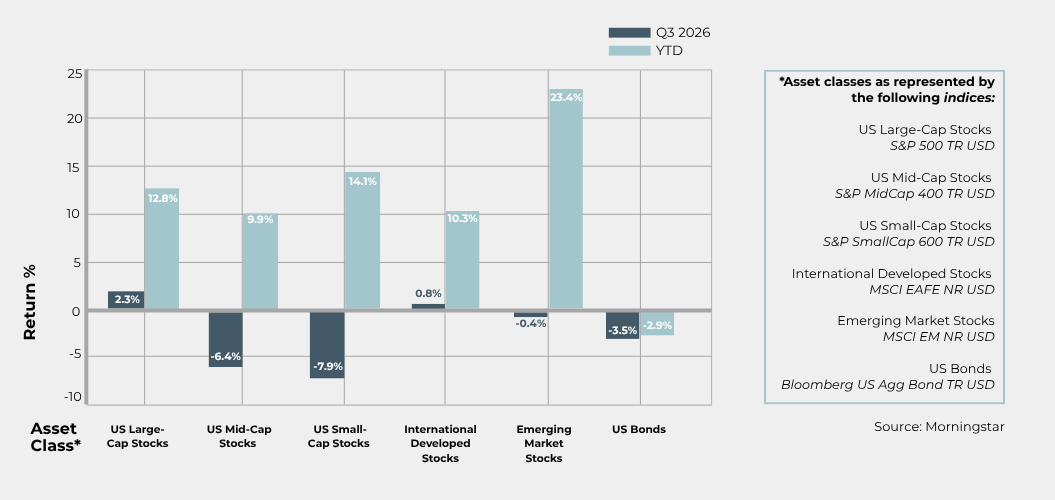

There had been plenty of recent buzz about whether the U.S. stock market had become overextended. It is a completely natural anxiety when markets trade at elevated levels, but the third quarter provided an example of how stock prices can be supported by improving corporate earnings expectations even during periods of elevated valuations.
The S&P 500 advanced during the quarter even as its forward price-to-earnings (P/E) ratio declined. At the same time, analysts raised their expectations for earnings over the following twelve months. This suggests that improving earnings expectations helped support stock prices even as investors assigned a somewhat lower valuation to those anticipated profits. Higher Treasury yields may also have weighed on valuations, as rising discount rates generally reduce the present value of future earnings.
The strength in earnings expectations was also evident in revisions for the third quarter. FactSet reported that analysts raised their consensus earnings-per-share estimates for S&P 500 companies by 1.4% between June 30 and September 30, compared with an average decline of 2.2% over the preceding five years. This marked the second consecutive quarter of upward revisions, which is an unusual pattern given analysts’ historical tendency to lower estimates as a reporting quarter approaches. The revisions suggest that expectations for corporate profitability held up better than usual despite higher energy prices and borrowing costs.
Artificial intelligence remained a prominent market theme, particularly through investor attention to demand for semiconductors and computing infrastructure. The quarter’s market performance also reflected broader earnings expectations and changing valuations. As companies continue investing in AI, an ongoing consideration for investors is the extent to which potential productivity gains and revenue growth will translate into profits sufficient enough to justify the capital being committed.
(Sources: Advisor Perspectives; FactSet.)

U.S. Treasury yields rose sharply during the third quarter. The 10-year Treasury yield began the quarter around 4.4% and ended September at approximately 5.3%. This increase brought renewed attention to the cost of financing after years in which exceptionally low interest rates made capital relatively inexpensive.
Longer-term Treasury yields reflect not only expectations for Federal Reserve policy, but also inflation expectations, government borrowing needs and the compensation investors require to hold longer-dated debt.
Japan added an international dimension to the changing interest-rate environment. In September, the Bank of Japan raised its policy rate to 1.25%, while the yield on Japan’s 10-year government bonds reached 3.0% for the first time since 1996. After decades of exceptionally low domestic interest rates, Japanese bonds have become more competitive with foreign fixed-income investments. If Japanese investors direct more capital toward domestic bonds and less toward overseas markets, demand for U.S. Treasuries could weaken, potentially adding upward pressure to U.S. yields. The extent of this effect remains uncertain, as global bond yields are influenced by many factors.
Mortgage rates rose alongside Treasury yields, with the average 30-year fixed mortgage rate reaching 7.0% by late September, up from approximately 6.4% at the end of June. Higher borrowing costs can directly impact both home affordability and business operations. For households, this can mean larger monthly payments. For businesses, higher interest rates generally increase the cost of servicing variable-rate debt and refinancing existing obligations. This elevates the financial hurdle for new projects and can put downward pressure on profit margins and asset valuations.
Higher interest rates can create better income opportunities through savings accounts and newly issued fixed-income securities. However, as investors demand higher yields on existing bonds, their prices generally fall. The overall effect depends on several factors, including the type of investment, its sensitivity to interest rates, and the broader economic environment.
(Sources: Federal Reserve Board; Euronews; Federal Reserve Bank of St. Louis, FRED; Freddie Mac, Primary Mortgage Market Survey; Yahoo Finance; Quartz.)

Energy prices climbed during the third quarter as renewed conflict in the Middle East disrupted oil supplies and raised concerns about the security of key shipping routes. According to the U.S. Energy Information Administration, Brent crude began July near $72 per barrel before surpassing $100 later that month. By September, average retail gasoline prices reached $4.35 per gallon, while diesel averaged $6.29 per gallon, adding pressure to household budgets and business operating costs alike.
The impact extended beyond the gas station. Diesel is a major input for trucking, agriculture, construction, and freight transportation, making it an important component of the cost of moving goods through the economy. When fuel prices rise, businesses may absorb the additional expense, pass it along to customers, or reduce spending elsewhere. The broader economic impact depends in part on how long prices remain elevated and how much flexibility businesses have to manage higher costs.
Higher energy prices also complicated the inflation outlook. September’s Consumer Price Index (CPI) rose 0.6% for the month, with gasoline accounting for more than half of the increase. Grocery prices, by contrast, declined 0.1%. This divergence illustrates how changes in individual categories can affect household budgets differently. If sustained, higher energy prices could add to inflationary pressure and make it more difficult for the Federal Reserve to bring inflation back toward its 2% target.
(Sources: U.S. Energy Information Administration; U.S. Bureau of Labor Statistics, Consumer Price Index Summary, September 2026.)

One of the more compelling aspects of the third quarter was that improving corporate earnings expectations coincided with a meaningful rise in borrowing costs. These developments tell different stories about the economy. Businesses were expected to generate stronger profits, yet the cost of financing those businesses and funding new investments was moving higher. Both can be true at the same time, and the balance between them may ultimately matter more than either development in isolation.
That tension will likely carry into the final months of the year. The midterm elections may shift expectations for economic policy, while inflation and interest rates will continue to influence how much consumers spend, how businesses invest, and what investors are willing to pay for future earnings. The important question is not simply what happens next, but whether the underlying conditions supporting economic growth and corporate profitability can withstand higher costs and changing policy expectations.
Markets rarely offer a single, unambiguous signal about what lies ahead. This quarter was a case in point. The challenge is understanding what the competing signals reveal about the economy, rather than assuming that any one of them tells the whole story.
Distinguishing between developments that meaningfully change the outlook and those that only serve to create short-term uncertainty can be guesswork in real time. A diversified investment approach remains important in navigating an economic environment shaped by shifting conditions.