

You may have recently heard about a new savings vehicle called a Trump Account. While the name has generated plenty of headlines, the concept is relatively straightforward. A Trump Account is a tax-advantaged investment account designed to help children build long-term wealth with no earned income requirement. Think of it as giving a child a head start on investing while also creating opportunities to learn about markets, saving, and the power of compounding over time. For families, grandparents, and others looking to invest in a child’s future, Trump Accounts may be worth understanding. These accounts are meant specifically for long-term retirement savings, not near-term support or education costs.
Below, we answer some of the most common questions we have received.
What is a Trump Account?
A Trump Account is a new tax-deferred investment account established under federal law for children under the age of 18. The account is owned by the child, while a parent or other authorized adult manages it until the child reaches adulthood. Funds are invested in eligible low-cost broad U.S. equity index funds and have the potential to grow over time through market appreciation and compounding.
For eligible children born between January 1, 2025, and December 31, 2028, the federal government provides a one-time $1,000 contribution once an account is established and applicable requirements are met.
How do I open a Trump Account?
Trump Accounts became available in 2026 through approved financial institutions and custodians. A parent, guardian, or other authorized individual can open the account on behalf of an eligible child. The child must generally be under age 18 and have a valid Social Security number.
As with other investment accounts, custodians may have their own account-opening procedures and documentation requirements.
How is a Trump Account funded?
There are several ways a Trump Account may be funded:
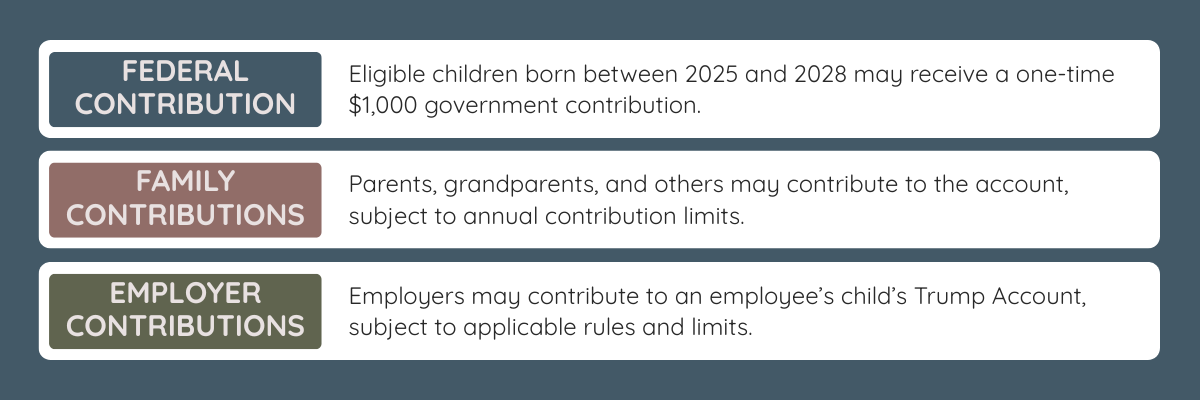
Current law allows up to $5,000 of annual contributions per child until the child turns 18, indexed for inflation in future years. Contributions to Trump Accounts are separate from IRA contribution limits.
What are the primary tax considerations?
Trump Accounts offer tax-deferred growth, meaning investment earnings are not taxed each year while they remain in the account. Instead, taxes are generally deferred until funds are withdrawn.
A few key points to keep in mind:
- Contributions by family members or other individuals are made with after-tax dollars, which do not result in a tax deduction but create basis in the account.
- Pre-tax contributions made by the government, employers, or charities do not create basis in the account.
- It is important to track basis in the account because that will impact the taxability of future distributions.
- Investment growth compounds tax-deferred while inside the account.
- Withdrawals are generally restricted before age 18, though there are a few limited exceptions.
- On January 1st of the year the child turns 18, the account is generally treated similarly to a traditional IRA and becomes subject to applicable IRA distribution rules.
Because the rules are still relatively new, additional guidance and clarifications may continue to be released.
When Should You Consider a Trump Account?
Like many planning strategies, the answer depends on the purpose of the gift.
If your goal is to help a child build long-term wealth and develop healthy investing habits, a Trump Account may be an attractive option. The greatest advantage is time. Even relatively small contributions made early in life have decades to compound and grow. Starting when a child is young can potentially create a meaningful financial resource later in life.
It’s also important to think about what you want the funds to accomplish. For some families, retirement-focused savings may be the primary objective. For others, helping a child learn about investing and financial responsibility may be just as valuable as the account balance itself.
Trump Accounts are worth considering if the child will receive the Federal seed money or employer contributions because this is essentially “free money.” They also generally make sense if you are looking for a long runway for tax-deferred growth (with no earned income requirement). They can also be appropriate when education funding and other non-retirement goals are already covered. Trump Accounts may be less suitable when education funding is the priority or liquidity is needed.
As with any planning decision, a Trump Account should be evaluated alongside other savings options, such as 529 plans, custodial accounts, and retirement accounts, to determine which tool best aligns with your family’s goals. We encourage clients to contact their Luminescent team to discuss strategies for their specific situation.
This presentation is not an offer or a solicitation to buy or sell securities. The information contained in this presentation has been compiled from third-party sources and is believed to be reliable; however, its accuracy is not guaranteed and should not be relied upon in any way whatsoever. This presentation may not be construed as investment, tax or legal advice and does not give investment recommendations. Any opinion included in this report constitutes our judgment as of the date of this report and is subject to change without notice.
Additional information, including management fees and expenses, is provided on our Form ADV Part 2 available upon request or at the SEC’s Investment Adviser Public Disclosure website, www.adviserinfo.sec.gov. Past performance is not a guarantee of future results.