
“The world hates change, yet it is the only thing that has brought progress.”
― Charles Kettering
The second quarter of 2026 had a little bit of everything. One of the largest IPOs in history renewed interest in the next wave of private companies entering the public markets, and investors navigated changes in both Federal Reserve leadership and the global geopolitical landscape. There was certainly no shortage of events to digest. The challenge in periods like this is not a lack of information, but determining which developments are likely to matter over time.
Change is a constant feature of financial markets, but not every change carries the same significance. What often matters is not the change itself, but how businesses, consumers, and markets respond to it over time. The second quarter provided several examples of this dynamic as the Federal Reserve moved into a new chapter, trade priorities continued to take shape, and global events influenced market expectations. Yet the framework for understanding those changes remained familiar. Corporate earnings, inflation, interest rates, and economic data continued to provide the foundation for how markets interpreted the environment.
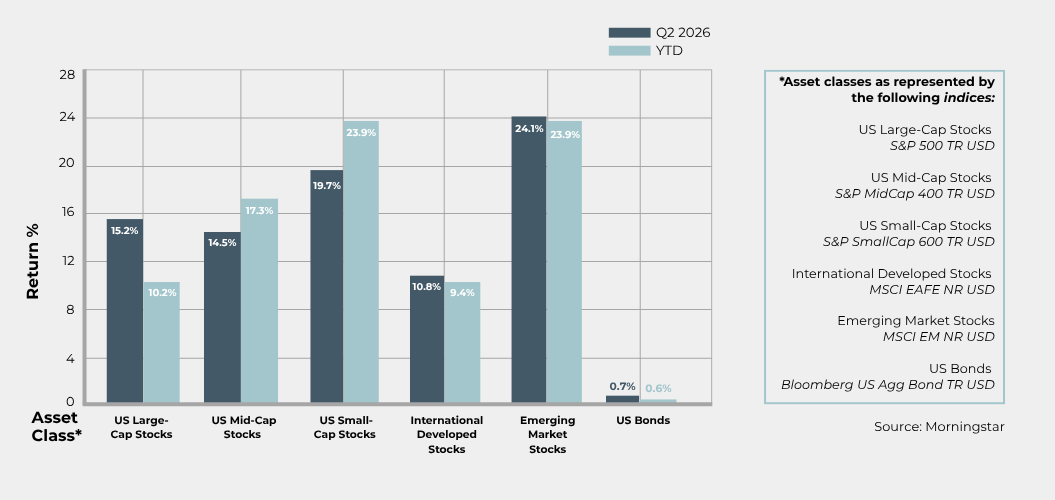
Several major market indexes reached new all-time highs even as investors sorted through a steady stream of new information. With NASA’s highly anticipated Artemis II launch and positive equity market performance occurring during the same period, the metaphors almost write themselves. We will resist the temptation and instead focus on the factors that shaped the quarter.



The second quarter marked a new chapter for the Federal Reserve as Kevin Warsh began his tenure as Chair, succeeding Jerome Powell following the conclusion of his term. Changes in Federal Reserve leadership are relatively rare events and often draw significant attention given the central bank’s influence on interest rates and financial conditions. Warsh was not new to the Federal Reserve, having previously served as a Federal Reserve Governor from 2006 to 2011. His return as Chair came at a time when policymakers faced ongoing inflation concerns and questions around the appropriate path for interest rates.
Warsh’s early tenure was closely watched for signs of whether a change in leadership would translate into a meaningful shift in monetary policy. At its June meeting, the Federal Reserve kept interest rates unchanged while noting that inflation remained above its 2% target. Rather than signaling an immediate path toward lower rates, policymakers pointed to the need for continued progress on inflation and indicated that future decisions would remain dependent on incoming economic data.
A key takeaway was the reassessment of expectations around the timing and direction of future rate moves. While earlier outlooks had centered on eventual rate reductions, the quarter ended with greater focus on how long rates may need to remain elevated as policymakers looked for further evidence that inflation was moving toward the Fed’s target. The transition also illustrated that monetary policy changes are typically gradual and data-dependent, with future decisions shaped by the balance between inflation, economic growth, and labor market conditions.

Diplomatic efforts in the Middle East gained momentum during the quarter following months of elevated tensions. In June, the United States and Iran announced an initial diplomatic framework aimed at reducing hostilities and supporting further negotiations, although questions remained regarding implementation and the durability of any agreement. The developments marked a notable change in the diplomatic landscape, even as regional security concerns remained unresolved.
Energy markets were among the areas most directly affected by the developments. Earlier in the quarter, disruptions involving the Strait of Hormuz contributed to volatility in global oil markets. The International Energy Agency (IEA) reported declines in oil supply, inventory draws, and disruptions to regional oil flows as the conflict affected energy markets. As expectations for a diplomatic resolution improved, oil prices declined from earlier highs as investors reassessed the likelihood of a prolonged supply disruption. The IEA noted, however, that a full recovery in oil flows would depend on operational and political developments, highlighting the continued connection between geopolitical stability, energy markets, and inflation expectations.

Treasury Secretary Scott Bessent outlined the administration’s approach to trade, domestic investment, and global competitiveness in a series of policy addresses throughout the quarter. He emphasized the connection between economic security and national security, arguing that the United States should place greater importance on reducing strategic dependencies and strengthening domestic capacity in critical areas. His remarks focused on supply chain resilience, domestic production, critical resources, and the use of trade policy tools to address potential vulnerabilities.
The discussion explores the balance between efficiency and resilience in the global economy. Over time, many companies have built supply chains around cost efficiency and global specialization, but recent disruptions have prompted businesses to reconsider sourcing strategies and build greater flexibility into their operations. Finding the appropriate balance between those objectives will likely remain an important consideration for businesses in the years ahead.
The effects of any policy changes are likely to emerge gradually rather than immediately. Companies will continue evaluating where to invest, how to structure their supply chains, and how to respond to evolving policy priorities. Over time, the economic impact will depend not only on government policy but also on how businesses adapt and whether those investments translate into stronger productivity and long-term growth.
Initial Public Offerings (IPOs) captured the spotlight as SpaceX’s public offering drew significant attention from investors. Several high-profile private companies, including Anthropic, also remained the subject of market discussion as investors looked ahead to the next wave of potential public offerings. For many investors, the question is not just which companies will go public, but what those headlines mean for their own portfolios.
For diversified investors, the immediate impact is often limited. A company’s public debut does not necessarily mean it becomes part of market indexes right away. Most broad market indexes use objective eligibility criteria, including factors such as size, liquidity, and trading history, before new companies are considered for inclusion.
A long-term investment approach does not depend on identifying the next individual market leader. Diversified portfolios are designed to evolve over time as companies grow, mature, and are replaced. By maintaining broad market exposure, investors can participate in innovation and economic growth without relying on the success of any single company.

Periods of transition often create a fair amount of uncertainty for investors, particularly when several occur at the same time. However, the second quarter offered a useful reminder that markets do not operate in a vacuum. A new Federal Reserve Chair, shifting geopolitical dynamics, evolving trade priorities, and renewed interest in public markets all influenced the investment landscape, but none of those developments existed independently from the economic framework surrounding them.
The importance of an event is rarely clear when it first occurs. Markets have repeatedly shown that the size of a headline does not always determine the size of its impact. Some developments that initially appear temporary can have lasting effects on policy and investment conditions, while major events may fade if they do not meaningfully change the economic outlook.
As the second half of 2026 begins, investors will continue to encounter new information and changing narratives. The ability to evaluate those developments in context remains an important part of understanding markets and making thoughtful investment decisions.

As more private companies enter public markets, attention will turn to their potential inclusion in major indexes over time.


As part of our ongoing commitment to helping clients stay organized and prepared, we are introducing a new resource: the Medical Grab ’N Go Envelope.